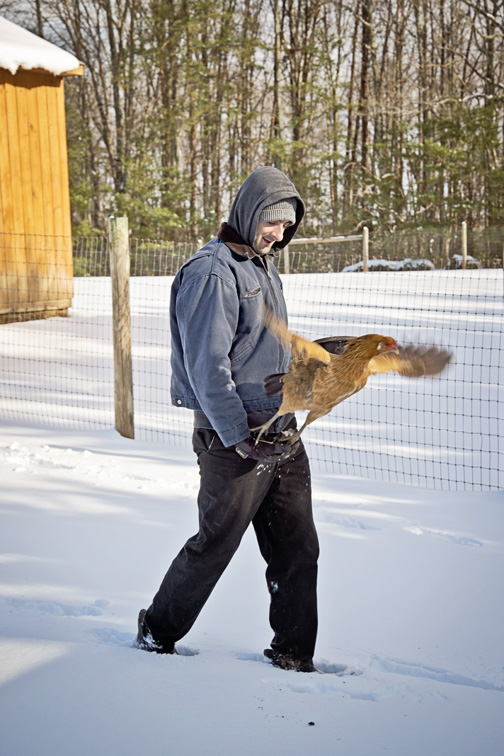
Did you know that chickens are not completely flightless? Chickens will fly short distances, usually in order to get over a fence or into a tree. In the picture the chicken doesn’t want to touch the snow, so she flew out of Kevin’s hands into the coop.
Tag: Chickens
-
Fun Farm Facts Friday – November 6th
It takes a fertilized egg being held at 88 degrees (incubation with a broody hen or a incubator) for an extended period of time for an embro to start forming, and 21 days at this temperature for a chick to hatch. Since farmers collect eggs daily it is highly unlikely that you will ever notice a difference between fertilized and non-fertilized eggs as a consumer.
-
Fun Farm Facts Friday – October 30th
Have you ever heard people talking about farm animals and been confused about the terminology they were using? With this week’s farm fact I’m here to help! Below you will find several terms used when describing the farm animals that we have. These are terms that you might see pop up from time to time on our blog.
Goats:
- Kid – Baby goat
- Doe – Female goat
- Doeling – A young female goat, generally under a year
- Buck – Male goat
- Buckling – Baby male goat, generally under a year
- Wether – Castrated male
- Billy – Older intact male
- Dam – Mother goat
- Sire – Father goat
Chickens:
- Chick – Baby chicken
- Pullet – Female chicken until they are old enough to lay eggs
- Hen – Female chicken of laying age
- Rooster – Male chicken (also called cock or cockerel)
Llamas:
- Cria – Baby llama
- Maiden – Female llama who has not been bred yet
- Yearling – One year old llama
- Dam – Mother goat
- Sire – Father goat
-
Fun Farm Facts Friday – October 23rd
Many people think that it is necessary to have a rooster with your hens in order to get eggs, but this isn’t true. Hens will lay with or without a rooster. Chickens lay eggs the same way humans ovulate, however instead of releasing one egg a month like humans do they release an egg daily to every few days.
-
How the rest of our animals eat
Back in May I wrote a post about what we feed our goats (here). Since the products that come off of our farm come from the milk that our goats supply we felt that it was important that our customers have an insight to the quality of our milk. The health of our animals is #1 to us so I thought our readers might also be interested in how the rest of the animals on The Freckled Farm are fed.
Llamas
Our llamas are strictly grass fed. They spend their days eating grass from the two pastures, munching on blackberry brambles and evergreen trees, and eating mountains of hay. During the winter we are literally stuffing the hay feeders all day. Because we do not give our llamas grain the quality of the hay is incredibly important. It is what keeps the weight on them, so the hay has to be nutrient rich. I have talked about the quality of our hay before. It’s something that we take very seriously. Most farmers that grow hay are small and only produce it for a small number of farms, so they do not want to go through the process and cost to be certified organic. The hay we use, however, is as close to organic as we can get! It’s chemical free and the farmer never uses drying agents. Good quality hay is one of the most important (and largest) purchases we make each year for our farm.
Chickens
Chickens eat everything. I’ve said it time and time again… chickens are not vegetarians like many big name chicken farmers would like you to believe. We feed our chickens a wide diet filled with proteins, veggies and greens, and grains. Our Chickens get a non-gmo grain and whatever food scraps that come out of our kitchen or garden. Our chickens also pick up lots of greens and bugs while they free range around the farm. You can tell if your chicken is getting a balanced diet by the color of their yolk, and our girls have bright orange yolks. I wrote an article about that as well (here).
On The Freckled Farm the health of our animals is incredibly important to us. We do everything we can to make sure all of our animals have a well-rounded, nutrient-rich diet.
-
Beating the Summer Heat
I love the heat! I’m comfortable even on the hottest days of the year… The cold is what I have trouble with (if you were following us last winter you are well aware of this!). The animals however don’t deal with the summer as well as I do. We have to take certain precautions to make sure that they are safe and healthy even in the hottest temperatures.
The goats deal with the heat the best. We just have to make sure they have constant fresh water and shade. During the hottest parts of the summer we may have to come out several times a day to make sure the water buckets are filled. A few summers ago, when we were dealing with extreme heat, I witnessed a bucket of water emptied in front of me between the llamas and goats. We have several buckets spread around. We always keep at least one in the barn and one in the pasture.
The chickens will tell you when they are too hot. They pant and egg production may go down. In very extreme heat chickens may become listless, which is a sign that they could be in danger of heat stroke. We help our chickens deal with the heat by making sure they always have fresh water, occasionally we will add ice to the water to keep it cooler longer, we give them frozen fruit and veggies to eat, and give them fruits with high water content like watermelon. It is also important that chickens have shade and space to dust bathe since this can help them regulate their temperature.
In the spring we shear both llamas to prepare them for the summer and like with the rest of the animals we make sure they always have fresh water and shade. Afton, our cream colored llama, does fairly well in the heat. He dust baths a lot, but is no where near as miserable as our black llama, Blue. Poor Blue struggles in the heat, so at least once a day, on the really hot days, we go out and hose Blue off. He loves to stand in the running water.
Heat can be very harmful to animals. It is extremely important that you take measures to keep your animals safe in the heat. For most fresh water and shade is enough, but keep a close eye on them to make sure they don’t need further help.
-
How to get a dark egg yolk
If you are a farmer or even just have a backyard chicken flock you understand the importance, and the satisfaction, of getting a dark egg yolk from your chicken! It’s an indication that your chickens are getting a healthy, nutrient rich diet. If your chicken has a healthy diet then they are transferring those nutrients to their eggs! Everyone benefits!
There are three nutrients that factor into the egg yolk coloring – Proteins, xanthophylls, and omega-3 fatty acids. All of these nutrients can be found naturally and if you are able to pasture your chickens they will pick up everything they need nutritionally and their yolks will be bright orange on their own without any supplementing. If your chickens live in a coop and do not get a lot of yard time there are ways of supplementing these nutrients so you too can get the dark egg yolks!
Proteins
It always drives me crazy when I see “vegetarian feed” on chicken meat or eggs at the grocery store. Chickens are not vegetarians. They are omnivores. They love and need meat! Bugs, mealworms, frogs, lizards, and even rodents. Letting your chickens have run of a pasture should give them all the protein they need, since they will spend their day chasing and eating bugs. If you need to supplement you can give them dried mealworms, black oil sunflower seeds, cooked meats, and cooked eggs. It’s a daily ritual for us to give our chickens black oil sunflower seeds when we are putting them up for the night. It makes it easier to get them into the coop and gives them an extra shot of protein, especially during the winter when there aren’t a lot of bugs out.
Xanthophylls
Xanthophylls play a large role in getting you those dark egg yolks. They can be found in plants like leafy greens, broccoli, collards, kale, and brussels sprouts. In the winter when greens are not always readily available you may notice that the yolks become a paler. Giving your chicken your veggie scraps and/or growing extra greens for them in your garden will help supplement their diet. Dandelion greens are also a great source of xanthophylls. During the spring and summer I have the kids pick the dandelions out of the yard and throw them in the coop. The chickens love them!
Omega-3 Fatty Acids
If you are looking to supplement Omega-3 Fatty Acids flax seeds and sea kelp will give the chickens what they need.
Making sure your chicken has a well rounded, nutrient rich diet is easy to do and will benefit everyone and once you start getting the dark orange yolks it’s hard to imagine eating eggs that don’t… It makes you an egg snob!
-
Fun Farm Fact Friday… July 17th
What goes into a dozen eggs? We learned earlier in the year that it takes 14 hours of sunlight for a chicken to make a single egg, but more than sunlight is needed… in fact it takes 4 pounds of feed to make one dozen eggs!
-
Fun Farm Fact Friday… July 10th
Chickens are incredibly interesting animals to have on the farm. They have huge personalities and are so much fun to watch. Chickens have over 200 distinct noises they can make for communicating. This fact doesn’t surprise me at all. Ours have quite a few calls that I recognize and know their purpose. They have a call they do when they have laid an egg, when they are looking for their flock mates, when they have found food, warning calls, look out calls, etc… and if you are around them long enough you can distinguish these calls yourself.