Author: Kevin

  • Avoid chemicals with Goat Milk Soap

    We often have customers ask us what makes our goat milk soap different from the bars they get at the store. The answer they get is probably more than they asked for, but it’s something we’re passionate about. So here goes.

    Aside from the obvious difference that ours is Goat Milk Soap, what you typically find in stores in the form of a bar soap is actually not soap at all. The major chemical companies that make up your major brand “soaps”, deodorants, toothpastes, etc have carefully marketed their products to look like soap and most people refer to these as soap. In fact if you look at the labelling these products do not contain the word soap anywhere on their label. They call themselves moisturizing bars, beauty bars, etc. but not soap. The reason for this is that the Food and Drug Administration has a pretty strict guideline for what constitutes soap: “To be regulated as “soap,” the product must be composed mainly of the “alkali salts of fatty acids,” that is, the material you get when you combine fats or oils with an alkali, such as lye.”

    The major chemical companies worked very hard to make products that were cheap, plentiful, and easy to manufacture. They took a bunch of synthetic chemicals like lathering agents and detergent cleansers in order to mimic soap. Many of these detergent bars are missing glycerin (a natural byproduct of the natural soap-making process), and other beneficial properties of real soap.

    The following is a list of some of the chemicals that are found in these detergent cleansers. The best way to avoid these chemicals is to use natural soap like ours:

    Triclosan: a key ingredient in antibacterial products. According to the FDA: “Animal studies have shown that triclosan alters hormone regulation.” and “Other studies in bacteria have raised the possibility that triclosan contributes to making bacteria resistant to antibiotics.”

    Propylene Glycol: a petroleum-based product that is dangerous when inhaled, an irritant, and a metabolic disruptor. Known to exert high levels of biochemical oxygen demand (BOD) during degradation in surface waters. This process can adversely affect aquatic life by consuming oxygen needed by aquatic organisms for survival.

    Polyethylene Glycol: can be a skin sensitizer, resulting in allergic contact dermatitis in some individuals.

    Sodium Lauryl Sulfate: causes skin irritation, there are studies that point to residual levels of Sodium Lauryl Sulfate in the brain, lungs, liver, and heart.  It has been linked to hormone imbalance because it mimics Estrogen.

    Butylated Hydroxytoluene: acts as a synthetic vitamin E. It is absorbed through skin. Long-term and repeated exposure caused renal and hepatic damage in rats.

    So how can you avoid chemical’s? By using OUR SOAP! Alkali salts of fatty acids from all natural vegetable oils which are formed when those oils are mixed with lye. The lye is not existent after the chemical reaction with the fatty acids in the oils and is no longer present in the final product. Then we add essential oils (literally the oils of the natural product itself) of things like lavender, tea tree, etc. And of course there is the goat milk, which comes directly from our small diary goat farm. We never add anything that isn’t natural and necessary for a great bar of soap.
  • Keeping predators out of your fencing

    Here at The Freckled Farm we have a tendency to go a little overboard in our planning of new projects. One example of this is our fencing. Most farms we have been to or visited use a pretty standard field fence for their pastures and their pens and smaller areas meant to separate kids, etc, are frequently made from wood or cattle panels. While we were researching what type of fencing we were using we were concerned with two things, predators and escapees. Goats are notorious escape artists so we wanted to make sure they would stay IN our fence, and stay safe.

    We chose a 5’ no-climb horse fence. This pretty much guarantees that our goats are staying put. Of course we still have to be careful not to put anything they could climb close to the fence. So that takes care of one of our two things, now on to the predators.

    In our area we have several predators to worry about when it comes to our goats. Coyotes, Bears, and more commonly, wandering dogs, can all be dangerous to your herd. On top of that we recently learned there is a mountain lion nearby.

    With 5-foot fencing we have a good deterrent. It is a high-tensile fence with posts every 8-10 feet so it would also be pretty tough to push or pull down. This should stop most dogs. Bears are unlikely to be motivated enough to do much here, etc. A fence though is not enough to protect your herd. Coyotes especially can jump a 5-foot fence with ease. I’m sure a mountain lion could do the same, if not scale the posts. So the best thing the fence really does is keep the herd in place, and keep predators from casually wandering into a meal.

    Electric fencing in addition to a good high-tensile barrier fence can go a long way to stop any would be attackers. You want to make sure you have an electric wire low, to prevent digging, but also one high to prevent jumping over the fence.

    After your fencing is in place you should really have a good guard animal. A guard can not only warn the herd of danger, they can fight off an attacker. Many people use dogs to achieve this, we use llamas. They are highly territorial and have the added benefit of eating what the goats do, which saves us money.

    Ultimately the best defense is a good offense. Take the steps necessary not to attract predators to your area. Make sure your animals have a guard animal. Keep them from wandering with a good strong fence that they cannot climb. In the end you should have at least a two-stage system. Keep predators out, but if they get in make sure they meet up with an aggressive foe standing between them an a free meal.

  • Kevin’s Favorite Soap

    At markets and craft shows we often have customers ask us what our favorite soaps are. This gave us an idea! Over the next four weeks you will learn the favorite soaps of the four members of The Freckled Farm family.

    I, Kevin, will start. My favorite soap is /\/\/\/\/\/\/\/\<— (drumroll)…….. Canine Shampoo.  Yes, that’s right. My favorite of all of our soaps is the one we made for dogs. I’ll give you a second to think of any appropriate jokes that apply.  .   .   .   . OK now that the initial shock has worn off let me explain. Canine Shampoo uses our standard oil blend of the base. Then we add ground oatmeal, lavender, tea tree, and rosemary essential oils. To me it is the perfect blend. It has a little exfoliant in the ground oatmeal. It’s earthy and smells great. I first started using it just as a shampoo bar, but quickly realized that there was no need to switch to another bar after washing my hair. So now this has become my whole body bar. It’s also really good for me because I have very oily skin and the mixture of lavender and tea tree work really well together.

    If you haven’t already you can subscribe to our blog to learn about the whole family’s favorite soaps as well as all sorts of fun facts and happenings around the farm.

  • How our Goat Milk Soaps get their color

    At The Freckled Farm Soap Company we do whatever we can to ensure that we are making products that are good for you. One of the ways we do that is to never use dyes or other colorants in our soap. Yet, our soaps have very different colors. So I thought it would be a good idea to go over what it is that gives our soaps their color.

    Many of our soaps end up being a nice tan/cream color. This is primarily due to the color that the milk turns when heated by the lye. We make our soaps at room temperature all year long, so there is always a little bit of variation in the exact temperature of the soap when it is set aside to cool.

    Aside from the ambient temperature there are a few other factors that influence color:

    Essential Oils: Though many essential oils come out mostly clear, some can have some natural color to them. The most notable of these in my mind is Orange Essential Oil. This is what gives our Sunrise Citrus soap its orange color.

    Other ingredients: Of course anything we add to the soap has the ability to change the color.

    We use a green tea powder to make our Lemongrass Green Tea soap since we don’t want to add any unnecessary water. This gives that soap a nice green/brown color. One thing to note about this soap is that due to the tea this soap is prone to oxidation before it cures. This can result in different shades of green and brown from the same batch of soap.

    Rosewood Salt is made with Himalayan Pink Salt, which naturally colors it.

    Deep Sea, is made with Kelp and Spirulina powders. The Spirulina especially gives that soap a deep green color.

    Honey Oatmeal is a warm honey color due to…. well, Honey!

    In the end anything that colors our soap, as nice as some of them are, are there only for their intended topical or aromatic benefits. The colors that those ingredients produce are just a nice addition.


  • Solar Powered Barn

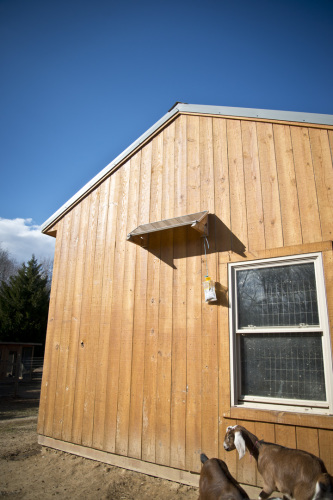
    When we decided to put up our barn there were the obvious questions: Where would it go? How large would it need to be? Yada yada yada. Well, after we had answered those questions there was one more. Do we need Electricity? This was a slightly complicated question, but in the end we came up with an answer that works for us… Solar Power.

    Solar 1 Blog

    We are always trying to do things that are going to be sustainable, but cost effective. Our barn is roughly 150 feet from our house. Given what we would need power for out there (a light or two, monitor, maybe a fan?), we decided it wasn’t cost effective to have power run all the way out. So we had it built without it and decided that we would figure it out later. Maybe we would look at solar power sometime in the future.

    Well, as it turned out, the future was sooner than I had thought. Through my old job outside of the house I had come to know the owner of a local solar power store. I happened to be doing some work at his office and I mentioned that I was thinking of putting solar in our barn. I asked him roughly what we would need to put in, mostly out of curiosity. What he told me is that we wouldn’t need nearly as much as I had thought. He ended up pulling together a few items for me and gave me a great deal on them as well. So for around $100 I walked out of there with almost everything I would need to get us started. Even though he gave me a great deal I’m sure you could find comparable prices from online retailers.

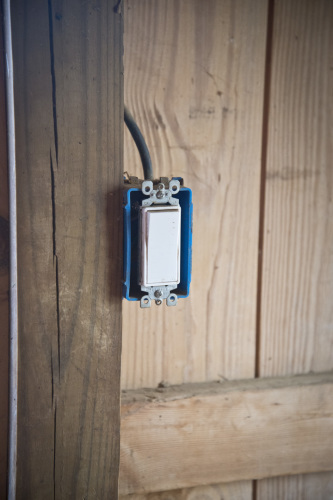
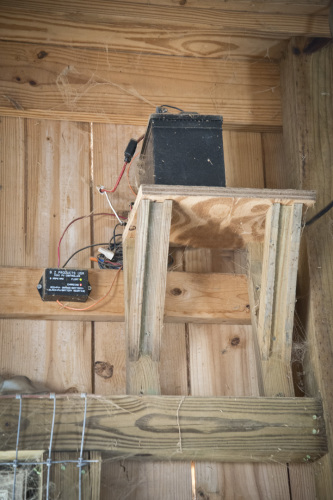
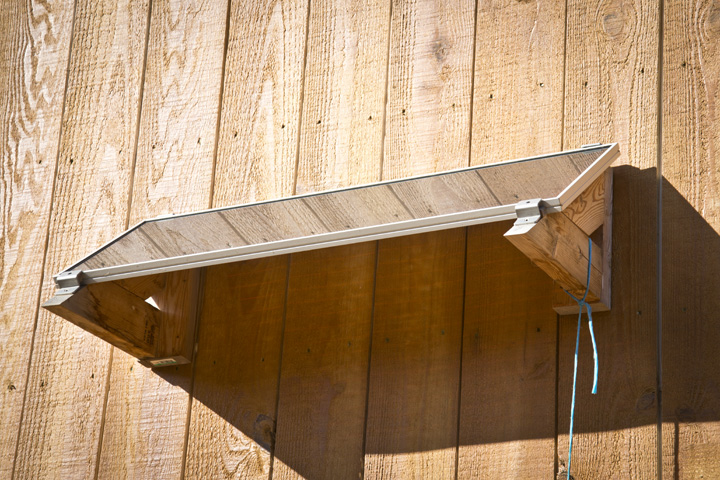
    The purchase included small 10-watt solar panel, in-line fuse, charge controller, 12v fluorescent ballast and an exterior light. My original plan was to put a cheap fluorescent hanging light in our barn, and the exterior light out on the front. What I ended up going with instead was an LED light fixture intended for an RV or camper. It should last longer without needing to change bulbs and uses a little less power. I also ended leaving off the exterior light, at least for now. So with the light, and the addition of a light switch and a riding lawnmower battery, we were in business.

    So here is our basic setup. Solar Panel –> Charge Controller –> Fuse –> Tractor Battery –> Light Switch –> LED Light. For the wiring I used some 10-gauge heavy-duty speaker wire that I had leftover from my days of running sound systems for bands. It’s not ideal, but it was free and should be plenty capable of handling the voltage.

    So after it was all done we ended up with a solar-powered barn for a little under $200 dollars. I should have enough capacity to add the exterior light if we ever decide we need it. We don’t end up using the light much unless we get home super late and have to do farm chores in the dark, or during birthing. Honestly the goats or llamas turn it on more than we do. In hindsight I probably should have put the switch where they couldn’t lean or jump on it. For birthing this year we added a 12v power to a wireless intercom we have so that we could monitor the girls while we are in the house. This stayed on the entirety of kidding season without running out of power.

    So there you have it. That’s how you can have a solar powered barn light for less than $200 dollars.Solar 2 Blog

    Solar 4 Blog

    Solar 3 Blog